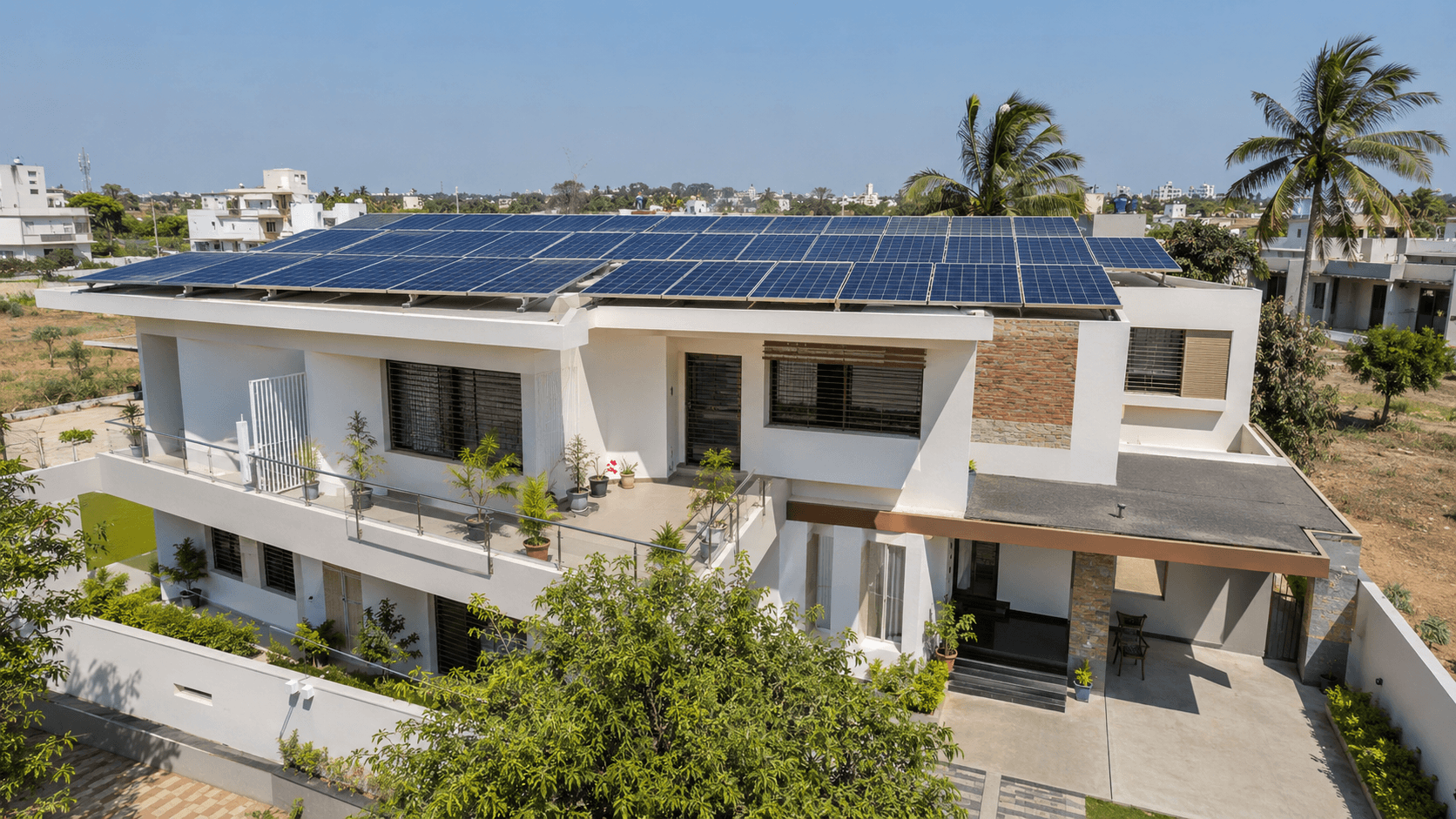
If you’ve landed here, you’ve probably already made your mind up that solar is worth it. Your PGVCL bill keeps climbing, your neighbour put panels up last summer, and now you just want one straight answer that nobody seems willing to give you:
What will a 3kW system actually cost my home in Junagadh or Keshod, after the subsidy, and how soon do I get my money back?
We install rooftop solar across Saurashtra, so we’ll answer it the way we’d answer it for our own family — with real numbers, no inflated promises, and the parts most websites quietly leave out.
The Quick Answer
For a quality 3kW rooftop system using branded panels, expect roughly ₹1.6 lakh to ₹2 lakh before subsidy in the Junagadh–Keshod area.
After the ₹78,000 central subsidy under PM Surya Ghar, your real out-of-pocket cost lands somewhere around ₹82,000 to ₹1.22 lakh.
Why the range and not one tidy figure?
Because the honest answer depends on three things:
- The panel brand and technology you pick
- Your roof type (a flat RCC terrace costs less to mount than a sloped or coastal high-wind roof near Keshod)
- Whether the Gujarat state top-up is active in the year you apply
Anyone who quotes you an exact rupee figure before seeing your roof is guessing — or cutting a corner you’ll pay for later.
What the ₹78,000 Subsidy Actually Is
The ₹78,000 comes from the central government’s PM Surya Ghar: Muft Bijli Yojana.
The amount isn’t random — it’s a slab system that rewards smaller residential setups:
| System Size | Central Subsidy |
| 1 kW | ₹30,000 |
| 2 kW | ₹60,000 |
| 3 kW and above | ₹78,000 (capped) |
Here’s the key thing to understand:
The subsidy maxes out at 3kW.
Install a 5kW or even a 10kW system and you still receive the same ₹78,000 from the centre.
That’s exactly why a 3kW system is the sweet spot for most homes — you squeeze out every rupee of central support, and 3kW comfortably covers a typical Saurashtra household’s usage.
Is There an Extra Gujarat State Subsidy?
You’ll see this claimed on some sites, so let’s be straight about it.
Gujarat has, in certain years, offered an additional state top-up of roughly ₹10,000–₹20,000 for systems up to 3kW, routed through GEDA (Gujarat Energy Development Agency) under the SURYA Gujarat programme.
But — and this is the part you won’t read on most installer pages — that top-up is subject to annual budget allocation and isn’t guaranteed every year.
So don’t build your budget around it.
Treat the ₹78,000 central subsidy as your reliable number, and treat any state top-up as a bonus you confirm for the current year before you sign anything.
We’ll check the live status for you when we do your assessment.
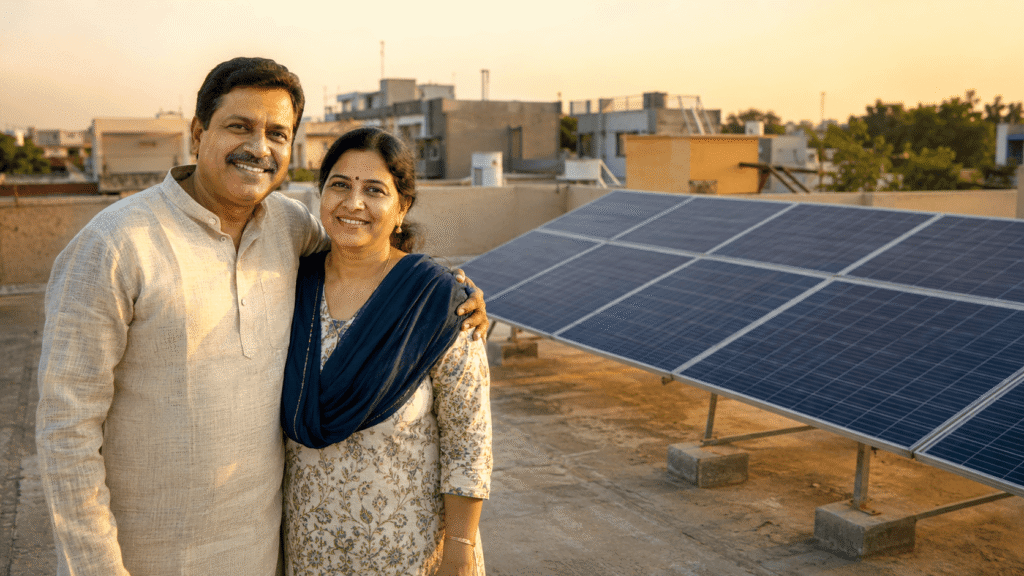
Full Price Breakdown for a Junagadh Home
When a quote says “3kW system,” that price is really a bundle of components.
Here’s roughly where your money goes:
| Component | What It Does |
| Solar panels (~6–8 modules) | Generate the power. Modern 550W+ panels mean fewer modules and less roof space. |
| Inverter | Converts DC to usable AC for your home. |
| Mounting structure | Holds the panels at the right angle and height. |
| Wiring, cables, safety gear | DC/AC cables, earthing, surge protection. |
| Net meter | Tracks power you send back to the grid. |
| Installation & commissioning | Labour, scaffolding, DISCOM paperwork. |
Two cost drivers are specific to our region and worth knowing about.
First, homes near Keshod and the coastal belt often need taller, sturdier mounting structures to handle higher wind loads — that adds a little to the structure cost, but skipping it is how cheap installations end up damaged in the first strong pre-monsoon storm.
Second, salt-laden coastal air corrodes low-grade hardware faster, so the fasteners and frame quality genuinely matter here in a way they don’t in inland Gujarat.
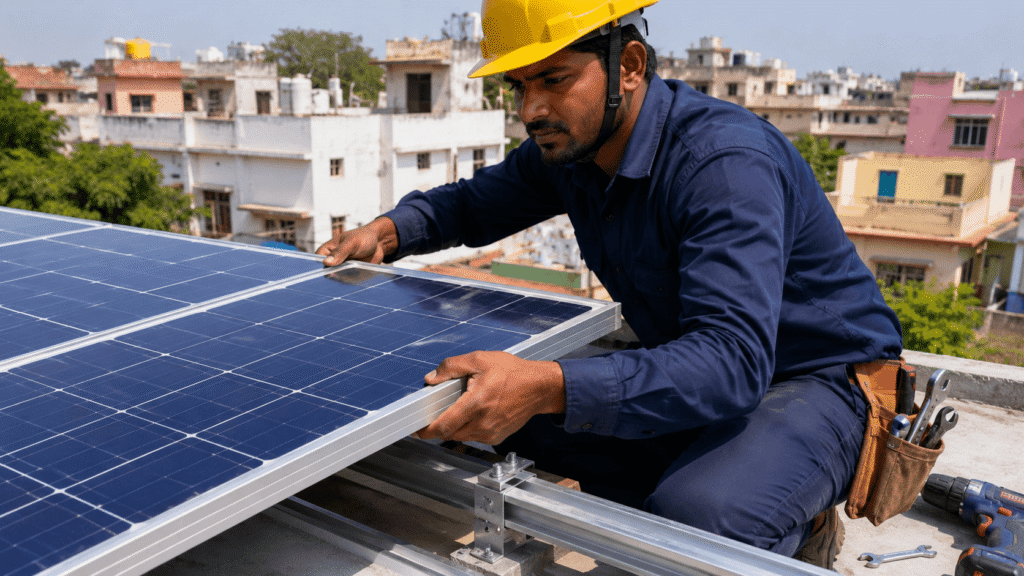
Which Panels We Install — And Why Brand Matters
We work with Waaree, Adani, and Polycab — all on the government’s ALMM list (Approved List of Models and Manufacturers).
This isn’t marketing.
Under PM Surya Ghar, your system must use ALMM-listed panels, or your subsidy claim gets rejected.
That single rule quietly disqualifies a lot of the rock-bottom quotes floating around WhatsApp.
A solar system is a 25-year decision.
The difference between a branded ALMM panel and a no-name import isn’t visible on day one — it shows up in year 8, when the cheap panel has degraded faster than promised and there’s no manufacturer left to honour the warranty.
A few thousand rupees saved upfront isn’t worth losing a decade of generation.
That’s the real reason we don’t sell the cheapest possible system.
How Much Will It Actually Save on Your PGVCL Bill?
A 3kW system in Gujarat generates around 12–15 units per day — Saurashtra gets 300-plus sunny days a year, which is part of why Gujarat is the number one state in India for rooftop solar.
That’s roughly 360–450 units a month, enough to offset 70–90% of a typical home’s bill.
In rupee terms, a household currently paying ₹2,000–₹4,000 a month to PGVCL can expect to save around ₹1,500–₹3,000 every month.
At that rate, your system pays for itself in roughly 3 to 5 years — and then keeps generating free power for another two decades.
After payback, the savings are pure return.
Net Metering With PGVCL
Junagadh and Keshod fall under PGVCL (Paschim Gujarat Vij Company Limited).
Residential net metering is allowed up to 10kW or your sanctioned load, whichever applies.
The process runs through:
- GEDA registration
- DISCOM net-meter approval
Feasibility typically takes around 15–30 days.
Good news for you:
Gujarat is one of the faster states in the country for this — approvals here often land in about 20 days, where some states drag on for months.
Being the leading rooftop-solar state has its advantages.
Get a Free Rooftop Assessment
We’re based right here in Keshod–Junagadh, not running this from a call centre three states away.
We’ll visit your roof, give you an honest size recommendation (not an oversized one to pad the bill), confirm the live subsidy status, and handle the entire PM Surya Ghar and net-metering paperwork end to end.
If you want a real number for your roof instead of a range, message us and we’ll set up a free assessment.
Frequently Asked Questions
How many panels are in a 3kW system?
Around 6–8 panels, depending on wattage.
With modern 550W+ modules you need fewer; older 400W panels need more.
What does a 3kW system cost in Gujarat after subsidy?
Roughly ₹82,000 to ₹1.22 lakh out of pocket for a branded system, after the ₹78,000 central subsidy.
The exact figure depends on panel brand and roof type.
How much electricity does a 3kW system produce per day in Gujarat?
About 12–15 units per day on average, thanks to Gujarat’s 300-plus sunny days a year.
Is the ₹78,000 subsidy available to every homeowner?
You need to:
- Own the roof
- Have a valid PGVCL connection
- Have enough shadow-free space (around 300 sq ft for 3kW)
- Use an ALMM-listed system through a registered vendor
Meet those and yes.
How long does the subsidy take to reach my account?
Around 30 days after installation, inspection, and net-meter commissioning.
It’s paid directly to your bank account.