


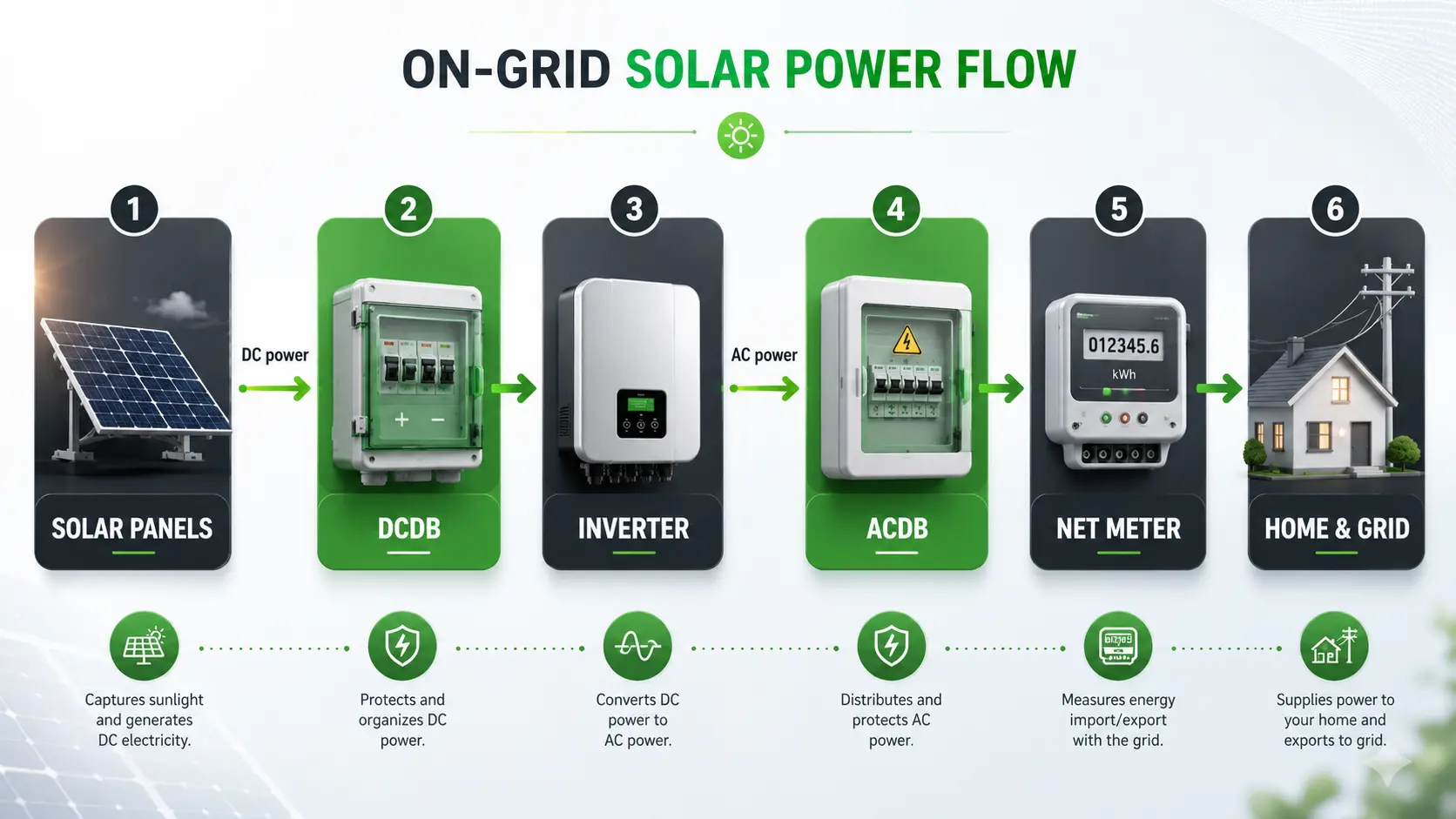
If you’ve looked at a solar quote or an installation and seen “ACDB” and “DCDB” listed, here’s the short answer: DCDB stands for DC Distribution Box and ACDB stands for AC Distribution Box. They are the two protection panels of a solar system — one guards the DC side between your panels and the inverter, the other guards the AC side between the inverter and your meter. Think of them as the fuse boxes of your solar plant, split into a DC half and an AC half because the two behave very differently.
That’s the definition. The rest of this guide explains where each box sits, what’s inside it, how the ratings are chosen, and — the part most articles skip — whether you actually need a separate box if your inverter already has some protection built in. If you’re a homeowner checking whether your installer cut corners, the first half is for you. If you’re an installer or electrician after sizing detail, jump to the ratings and components sections.
Where ACDB and DCDB Sit in a Solar System
Every rooftop solar system follows the same power path, and the two boxes sit at two specific points in it:
Solar Panels → DCDB → Inverter → ACDB → Net Meter → Home & Grid
The DCDB comes first, on the panel side, carrying direct current. The ACDB comes after the inverter, on the alternating-current side. Once you can picture that chain, everything else about these boxes makes sense.
The DC Side — Panels to Inverter
Solar panels produce DC (direct current) whenever light hits them. The strings of panels run down from the roof into the DCDB, which combines them, protects them, and feeds a clean, safe DC supply into the inverter’s input. On larger plants this job is sometimes split between a separate combiner box and the DCDB, but on a normal home system the DCDB handles it all.
The AC Side — Inverter to Meter and Load
The inverter converts that DC into AC (alternating current) — the type of power your home and the grid actually use. From there the supply passes through the ACDB, which protects the AC circuit and routes power onward to your net meter and your home’s main distribution board. On a single-phase home this is a 230V circuit; on a larger three-phase connection it’s 415V, and the ACDB is built to match.
Where Batteries Change the Picture
If your system has batteries — an off-grid or hybrid setup — there’s an extra DC circuit for the charge controller and battery bank, so the DC-side protection is more involved than on a plain grid-tied plant. If that’s your setup, our hybrid solar system and off-grid solar system pages explain how those systems are wired.
What Is a DCDB? Function and Components
The DCDB has one core job: make the DC side of your system safe. It isolates the panel array so a technician can switch the DC power off before touching anything, protects against overcurrent, and diverts surges away from your expensive inverter.
What’s Inside a DCDB
DC isolator (disconnect switch) — lets you manually break the DC circuit under load. This device must be DC-rated, and here’s why it matters: a DC arc doesn’t self-extinguish the way an AC arc does. AC crosses zero voltage 100 times a second, which naturally snuffs out an arc; DC holds steady, so a switch not built for DC can keep arcing and start a fire. This is the single most important technical point on this page.
DC MCB or MCCB — overcurrent protection, DC-rated and polarity-aware.
String fuses (gPV type) — genuinely required only when you have three or more strings wired in parallel. With one or two strings, a fault can’t push more current back than the module is already rated for, so fuses aren’t strictly needed. A lot of guides get this wrong; a good installer sizes to the actual design.
DC SPD (Surge Protection Device, Type 2, 1000V DC) — sends lightning-induced surges safely to earth before they reach the inverter. On the open, exposed rooftops common across Saurashtra, and through the monsoon storm season, this is a component you don’t want skipped.
Busbars, MC4 entry glands and an IP65 enclosure — so the box survives outdoors. (→ you can format the 5 points above as a bullet list in Elementor if you prefer)
Typical DCDB Ratings and How They’re Chosen
Two numbers decide the DCDB spec. The voltage rating must be higher than your array’s open-circuit voltage (Voc) at the coldest temperature you expect — because Voc actually rises as temperature drops, and the datasheet figure is measured at 25°C. Miss this and devices can be over-stressed on a cold morning. The current devices are sized at roughly 1.25 times the array’s short-circuit current (Isc). Exact figures depend on the specific module and how the strings are configured, so these should always come from the system design, not a generic chart. (→ ADD your real 3kW and 5kW DC ratings here from Avirat’s BOM)
What Is an ACDB? Function and Components
The ACDB protects the AC output of your inverter, gives a safe disconnect point between your plant and the grid, and is the box the DISCOM inspector looks for during your net-metering check.
What’s Inside an ACDB
AC MCB or MCCB — sized to the inverter’s rated AC output current, not to the panel capacity, which is a common mistake.
AC SPD (Type 2) — protects the inverter’s AC stage and the appliances downstream from surges.
RCCB / RCD — earth-leakage protection, where the installation calls for it.
Isolator or changeover switch — for clean disconnection during maintenance or grid work.
Indicator lamps, energy-meter provision and contactor — where specified.
Single-Phase vs Three-Phase ACDB
Most homes run on a 230V single-phase supply; larger homes and commercial sites use 415V three-phase. The ACDB has to match the inverter’s output configuration — it’s a technical requirement, not a preference.
ACDB vs DCDB — The Key Differences
| Feature | DCDB (DC Distribution Box) | ACDB (AC Distribution Box) |
|---|---|---|
| Full form | DC Distribution Box | AC Distribution Box |
| Position in system | Between panels and inverter | Between inverter and meter/grid |
| Current type | Direct current (DC) | Alternating current (AC) |
| Typical voltage | Up to 1000V DC | 230V (1-phase) / 415V (3-phase) |
| Key components | DC isolator, DC MCB, string fuses, DC SPD | AC MCB, AC SPD, RCCB, isolator |
| Main risk it guards | DC arc faults, array surges | AC faults, earth leakage, grid surges |
| Enclosure | IP65, outdoor-rated | IP65, outdoor-rated |
The reason these can’t be swapped comes down to physics: DC and AC faults behave differently, and a device built to break one safely will fail at the other. A DC-rated isolator in an AC box is overkill; an AC device in a DC box is dangerous. So a proper install uses both, each rated for its own side.
Why ACDB and DCDB Matter — The Safety Case
These two boxes are a small part of the total system cost and one of the most common places a low-quote vendor quietly cuts corners. Here’s what they actually protect you from.
Fault isolation. Solar panels produce voltage whenever there’s daylight — you can’t switch them off like a normal appliance. Without a proper DC disconnect, there’s no safe way for anyone to work on the array. The DCDB gives that off switch.
Surge and lightning. A lightning strike doesn’t have to hit your house to hurt it. A nearby strike induces a voltage spike that travels down the wiring and can destroy your inverter in an instant. The SPD is a cheap component whose entire job is to sacrifice itself and save the expensive one. On exposed Saurashtra rooftops during monsoon, it earns its place.
Fire risk. Undersized or non-DC-rated protective devices can arc, and as explained above, a DC arc sustains itself. Correctly rated components in a proper enclosure are what keep a fault from becoming a fire.
None of this is about scaring you — it’s about knowing what to check. When you compare two quotes and one is noticeably cheaper, the balance-of-system components like these are often where the difference hides.
Are ACDB and DCDB Mandatory in India?
In practice, yes — and here’s why. Both boxes appear on the single-line diagram (SLD) you submit for net-metering approval, and DISCOMs expect to see them at inspection — PGVCL across Saurashtra, and MVVNL for our Lucknow customers. MNRE-empanelled vendor specifications also reference them as standard. The short version: if you want a sanctioned, subsidy-eligible, net-metered system, these boxes aren’t optional extras — they’re part of an approvable installation.
Where to Get ACDB and DCDB Units
For homeowners, you don’t need to source these yourself — a proper EPC quote includes them, correctly sized, as part of the installation. That’s how Avirat supplies them: matched to your system design, installed and certified.
For installers and dealers sourcing components to build their own systems, these are standard balance-of-system (BOS) parts available from specialist suppliers — for example, Parikshit Ventures, which supplies solar BOS components including ACDB and DCDB units.
Common Questions About ACDB and DCDB
What is the full form of ACDB and DCDB?
ACDB stands for AC Distribution Box and DCDB stands for DC Distribution Box.
What is the difference between ACDB and DCDB in a solar system?
The DCDB sits before the inverter and protects the DC side; the ACDB sits after the inverter and protects the AC side. Their protective devices are rated for different current types and are not interchangeable.
Is a DCDB necessary if my inverter has a built-in DC isolator?
Usually yes. A built-in isolator helps, but most rooftop installs still use a separate, accessible DCDB so there’s a clearly marked disconnect point outside the inverter — and the AC side still needs its ACDB.
What MCB rating is required in a DCDB for a 3kW solar system?
The device voltage must exceed the array’s cold-weather Voc, and current devices are sized at roughly 1.25 times Isc. The exact rating depends on your specific modules and string layout.
Do ACDB and DCDB need surge protection devices (SPD)?
For most rooftop installs, yes — especially on open or lightning-prone rooftops. Use Type 2 SPDs, and the DC-side SPD must be DC-rated.
Talk to Avirat Energy
Avirat Energy is a rooftop solar EPC company based in Keshod–Junagadh, serving Saurashtra and Gujarat since 2020. We use ALMM-listed panels from Waaree, Adani and Polycab, and every system we install includes properly sized ACDB and DCDB protection as standard — not as an afterthought. With 10,150+ domestic clients served and a 4.9-star rating across 79 Google reviews, we build systems to last. Get a free quote.